Property Passport · Second Homes
What is a Property Passport for a second home?
Owning a second home can be wonderful. It can also be surprisingly hard to keep track of.
A visit happens. A repair is done. A leak is fixed. New WiFi is installed. A routine check confirms everything is fine. Months later, you may remember that these things happened, but not always exactly when, by whom, or with what evidence.
That is where a Property Passport comes in.
A Property Passport is a structured, living record of what happens at a property over time. Instead of keeping scattered emails, invoices, photos, and notes in different places, everything is documented in one clear history.
It is not just a file folder. It is not just storage. It is a way of building continuity.
More than a folder of documents
Most second-home owners already have documentation somewhere.
A few photos on a phone. A plumber's invoice in email. A note about a visit written in a message thread. Maybe an old inspection report saved in downloads. None of that is useless, but it is fragmented.
A Property Passport brings those fragments together and turns them into a readable property history.
That means each meaningful activity can be connected to a date, a contractor, a reason, and supporting evidence. Over time, that creates something much more valuable than a random collection of files. It creates context.
A living history of the property
A well-kept property is not just maintained physically. It is also maintained informationally.
If a second home is visited regularly, checked properly, and looked after through local support, that work should not disappear the moment the visit ends. It should become part of the property's record.
A Property Passport can include routine visits, inspections, incident response, contractor coordination, repairs, upgrades, and owner-facing reports. Each item helps explain the condition and care history of the home.
That matters because properties do not stand still. They evolve through use, weather, absence, maintenance, and occasional problems. Good documentation helps an owner understand that story clearly.
What gets recorded over time
A Property Passport can include many different kinds of entries, depending on the property and the level of care involved.
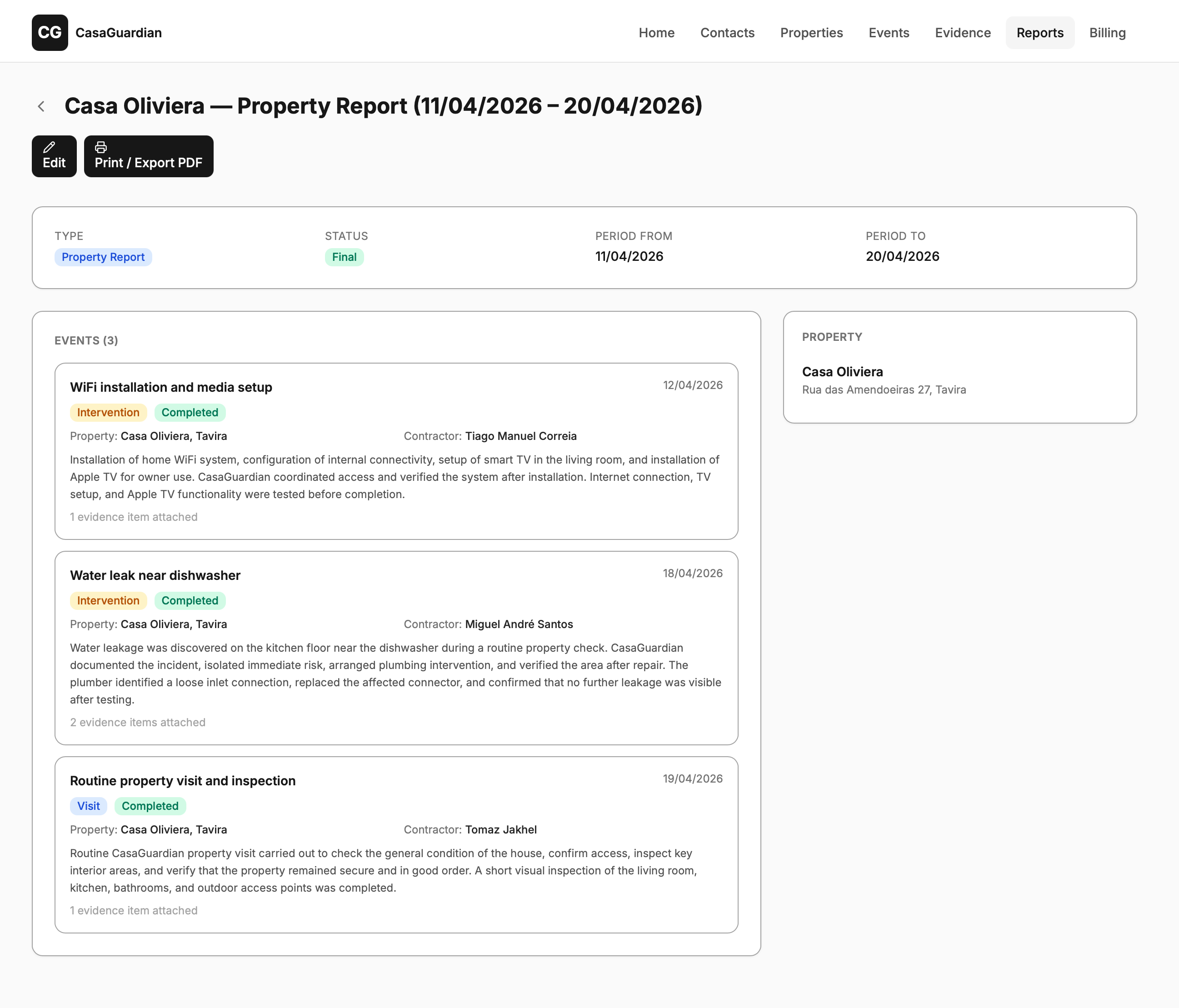
It may include routine property visits that confirm the home is secure and in good order. It may include technical improvements, such as home WiFi installation or media setup. It may include incident response, such as a leak near a dishwasher, with before-and-after evidence and a record of who attended and what was done.
In practice, that means the owner can look back and see not just that "something was fixed," but what happened, when it happened, who handled it, and how it was resolved.
That kind of clarity is especially useful for second homes, where the owner is not always physically present.
Why it matters for owners
For many owners, peace of mind comes from knowing that the property is being looked after properly. But peace of mind becomes much stronger when it is supported by documentation.
A Property Passport helps reduce uncertainty. It makes it easier to review what has happened at the home. It makes communication clearer. It helps separate assumptions from facts.
It can also be useful later. A structured history may help when reviewing maintenance patterns, checking past incidents, planning future work, or simply understanding how the home has been cared for over time.
And perhaps most importantly, it builds trust. Not abstract trust, but practical trust built on visible records.
What it can look like in practice
A real Property Passport is not theoretical. It is built entry by entry.
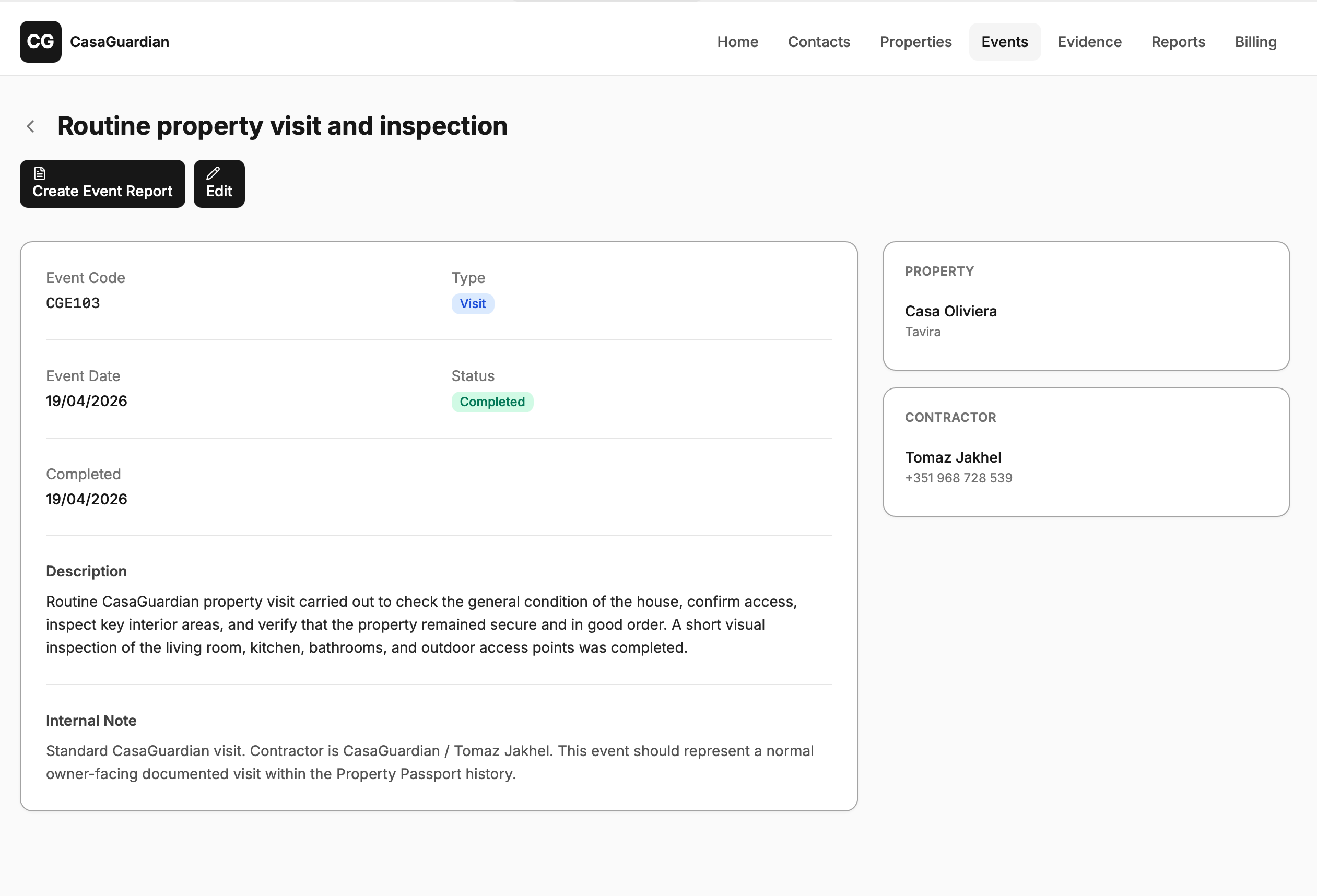
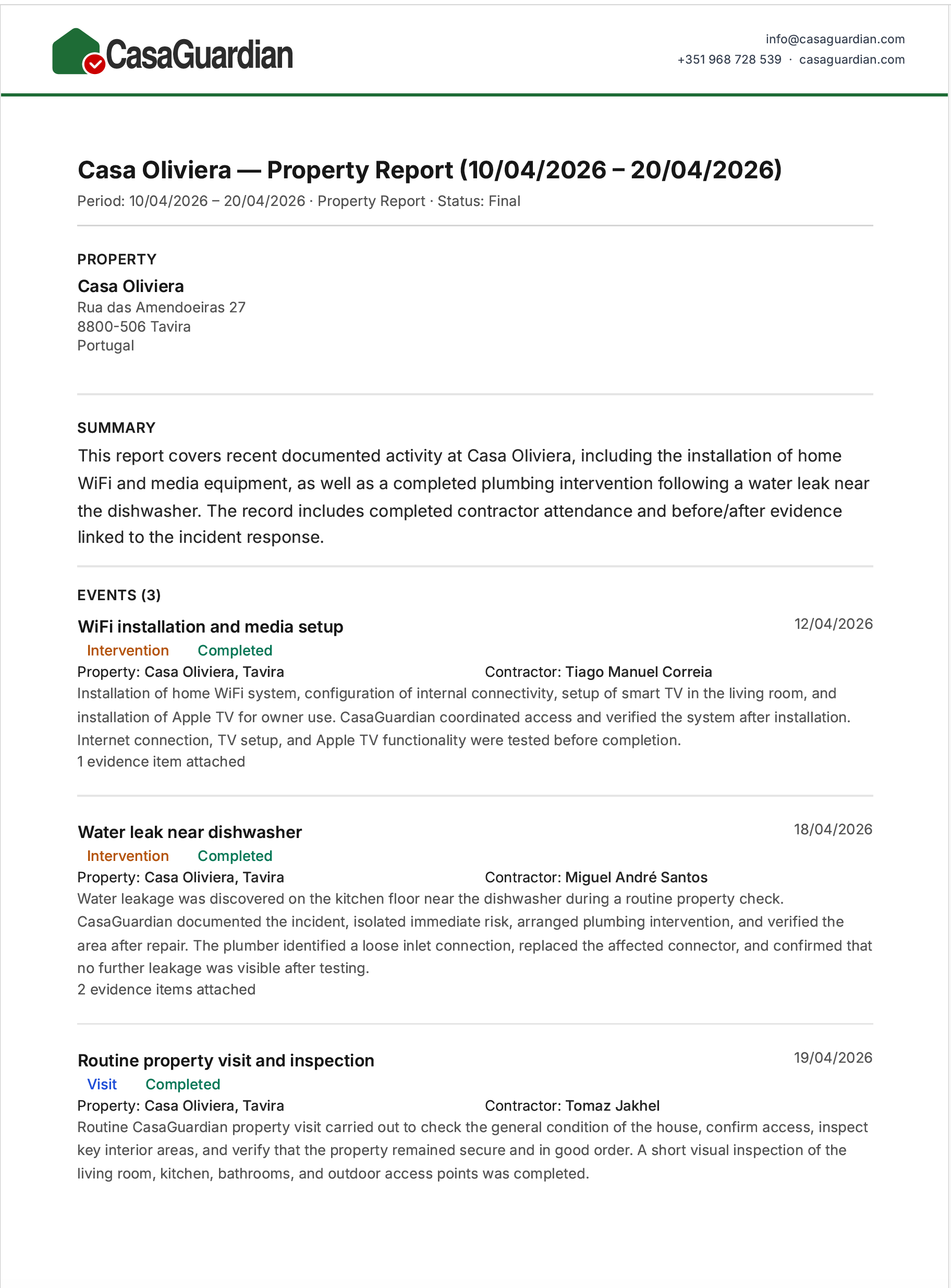
For example, one property record might include a documented WiFi and media installation, a plumbing intervention after a water leak near a dishwasher, and a routine property visit carried out afterward to confirm general condition and order. Each event can be linked to the relevant contractor, dated properly, and supported by evidence where needed.
That gives the owner something simple but powerful: a readable timeline of care.
You do not have to reconstruct the past from memory. You can see it.
Built over time, not all at once
A Property Passport is not something that appears fully formed on day one. It grows gradually.
That is actually one of its strengths. Each visit, each report, each intervention adds another layer of confidence. Over time, the property becomes easier to understand, easier to manage, and easier to trust.
For a second-home owner, that can make a real difference.
Because looking after a property is one thing.
Being able to show how it has been looked after is another.
The value of a Property Passport will grow even more in the years ahead.
As AI tools become more practical and reliable, they will make it easier to review the condition of a property in a clearer and more structured way. That will not apply only to visible issues, but increasingly also to equipment, systems, and technical infrastructure such as appliances, installations, and recurring maintenance needs.
With a properly built Property Passport, those tools will be able to work with a much stronger foundation. Instead of looking at isolated documents or one-off photos, they will be able to read a continuous property history. That can make it easier to identify patterns, flag risks earlier, and help owners understand what may need attention next.
Over time, this could support more forward-looking care of the property. Equipment servicing may be anticipated earlier. Replacement cycles may become easier to plan. New systems or upgrades may be added more modularly, with each addition becoming part of the long-term record rather than another disconnected file.
For owners, that means something simple but important: even greater clarity, less uncertainty, and more confident decision-making.
A well-structured Property Passport is not only useful for understanding the past. It can also become the foundation for managing the future of a second home more intelligently.